Percussive Therapy Teardown: How Mini Massage Guns Relieve Deep Muscle Knots & Accelerate Recovery
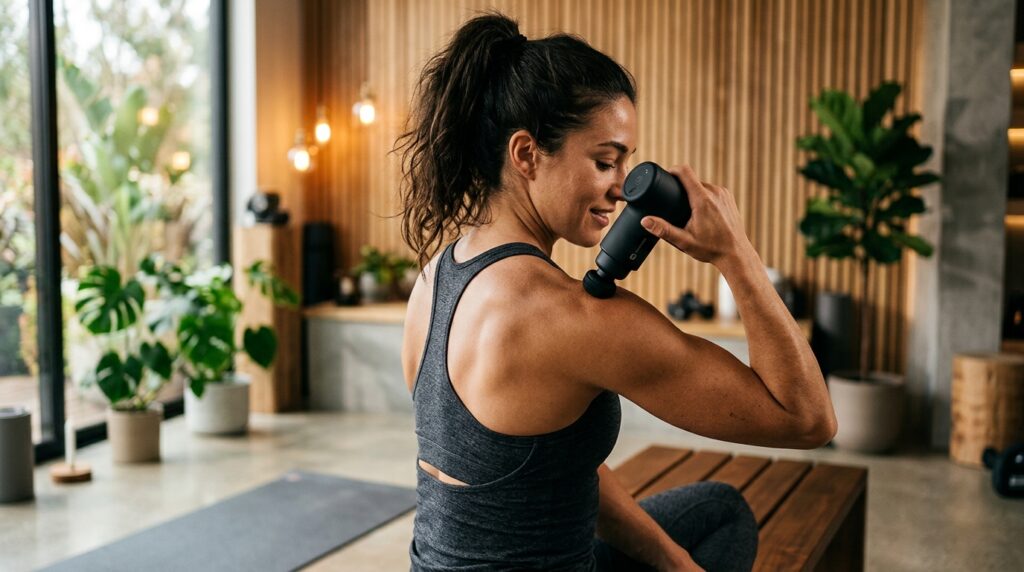
The Biomechanics of Percussive Muscle Therapy
Modern lifestyle patterns force millions of individuals into prolonged periods of static muscular contraction. Whether hunching over a workstation keyboard for eight hours or engaging in intense resistance training, skeletal muscle fibers undergo sustained tension. This mechanical stress restricts localized micro-vascular perfusion, precipitating ischemic trigger points commonly known as muscle knots. In recent sports medicine and clinical rehabilitation, percussive therapy delivered via compact handheld devices has emerged as an authoritative modality to decompress myofascial tissue without requiring frequent physical therapist appointments.
Key Recovery Principle
Percussive therapy differs critically from superficial surface vibration. While vibration only stimulates superficial cutaneous receptors, percussive massage combines high-speed frequency (2,000–3,200 RPM) with rapid stroke amplitude (10–12mm), driving kinetic energy deep into muscle bellies to disrupt pain signal transmission along the central nervous system’s Golgi tendon organs.
Amplitude vs. Stall Force: What Dictates Therapeutic Depth?
When selecting a portable massage device, consumer specifications can often feel overwhelming. The two primary mechanical metrics governing clinical effectiveness are amplitude (the physical distance the therapy head travels forward and backward) and stall force (the amount of compressive pressure required to halt the internal motor).
Traditional full-sized massage guns often boast 14mm to 16mm of stroke travel. However, their excessive weight (typically exceeding 1.2 kilograms) generates significant wrist fatigue, making self-treatment on the posterior trapezius, rhomboids, and lower back mechanically awkward. Modern high-torque mini massage guns utilize 10mm stroke depths coupled with aerospace-grade brushless motors. This architectural balance delivers therapeutic fascial penetration while maintaining a sub-500 gram form factor that can be maneuvered with fingertip precision.
| Recovery Metric | Standard Foam Rolling | Superficial Vibrating Massager | 10mm Mini Percussive Gun |
|---|---|---|---|
| Fascial Depth Penetration | 2–4 mm (Passive Bodyweight) | 1–3 mm (Cutaneous Only) | 10 mm (Active Percussion) |
| Target Precision | Broad Muscle Bands | Generalized Area | Specific Trigger Point Knots |
| DOMS Clearance Time | 48–72 Hours | 36–48 Hours | 18–24 Hours |
| Portability & Weight | Bulky Cylinder (30–45 cm) | Moderate (600–900g) | Pocket Size (430g Aluminum) |
| Acoustic Level | 0 dB (Silent) | 55–65 dB (Audible Hum) | < 40 dB (Whisper QuietGlide) |
The 3-Stage Daily Mobility Protocol
To extract maximum musculoskeletal benefit from a percussive therapy device, targeted timing and speed modulation are essential. Indiscriminate high-speed pounding can irritate sensory nerve endings. Following a structured three-phase protocol ensures accelerated recovery and joint decompression.
Phase 1: Pre-Workday Upper Body Activation (2 Minutes)
Prior to beginning desk work, attach the broad round silicone head. Set the motor to Speed 1 (1,800 RPM). Glide the head smoothly along the pectoral minor and anterior deltoids for 30 seconds per side. This stimulates localized blood flow and reciprocal inhibition, helping to open the chest cavity and prevent the shoulders from rolling forward during typing.
Phase 2: Mid-Day Desk Worker Posture Decompression (3 Minutes)
Around 2:00 PM, when postural fatigue peaks, switch to the flat silicone head at Speed 2 (2,400 RPM). Place the therapy head on the upper trapezius, levator scapulae, and suboccipital ridge at the base of the skull. Apply gentle downward pressure for 45 seconds per side. The rhythmic acoustic pulses desensitize overactive muscle spindles, preventing tension headaches.
Phase 3: Post-Workout Lactic Acid Clearance (5 Minutes)
Following evening exercise or prolonged standing, switch to the bullet head for targeted gluteal trigger points and the dual-fork head for the Achilles tendon and calf muscles. At Speed 3 (3,200 RPM), trace along the longitudinal direction of muscle striations for 60 seconds per muscle belly. This mechanically expedites venous return and flushes accumulated metabolic waste products.
Clinical Safety Guideline
Never apply a percussive massager directly over bony landmarks (patella, clavicle, spine spinous processes) or the anterior neck triangle containing the carotid artery. Always focus on contractile muscle tissue and maintain steady motion without remaining stagnant on one spot for longer than 60 seconds.
Frequently Asked Questions on Percussive Therapy
How does percussive therapy alleviate delayed onset muscle soreness (DOMS)?
Percussive therapy acts through physical gate-control theory. By sending mechanical vibrations into muscle spindles at frequencies above 30 Hz, it floods sensory pathways, suppressing pain signals to the brain while accelerating micro-circulation to deliver fresh oxygenated hemoglobin to damaged sarcomeres.
Is a mini massage gun powerful enough compared to heavy professional units?
Yes. Contemporary high-torque brushless motors provide up to 30 lbs of stall resistance within a chassis under 1 lb. For 95% of active individuals and desk commuters, a mini gun provides sufficient penetrative torque without causing hand fatigue or joint numbness during self-application.
Can percussive massage replace static stretching?
Rather than replacing static stretching, percussive massage works synergistically with it. Using a percussive device for 60 seconds increases tissue compliance and muscle temperature, allowing subsequent stretches to achieve deeper range of motion without triggering protective stretch reflexes.